How to Adapt to Future Trends in Healthcare Manufacturing

Time:2026-10-09 Author:Aria
0%

Healthcare manufacturing is entering a period of rapid, practical change. Future Trends In Healthcare Manufacturing Technology will influence how facilities design products, manage risks, and serve patients. Connected equipment, artificial intelligence, robotics, and advanced analytics are moving beyond pilot projects. They are becoming part of daily production. A modern facility may include sensors monitoring temperature, automated inspection cameras, and digital records tracking each component. These tools can improve consistency, but technology alone cannot guarantee quality.

Adaptation requires disciplined planning and informed judgment. Manufacturers should connect new systems with Good Manufacturing Practice, risk-based validation, cybersecurity controls, and clear employee training. Experienced engineers can test whether an automated process performs reliably under stress, not only during a successful demonstration. Quality teams must also review data integrity, supplier performance, maintenance records, and change-control procedures. Small weaknesses matter. A missing calibration record can delay an entire batch.

Workforce readiness deserves equal attention. Operators need practical instruction, while leaders need realistic performance measures. Some organizations may invest heavily in automation before understanding their production bottlenecks. That mistake is easy to make. A better approach begins with measurable needs, such as reducing inspection errors or shortening equipment downtime. Sustainability should also guide decisions, including energy use, material waste, packaging, and equipment life cycles. No forecast is perfect. Healthcare manufacturers must remain willing to question assumptions, learn from deviations, and revise their plans. By combining evidence, professional expertise, and transparent oversight, they can adopt future technologies without compromising patient safety or product reliability.
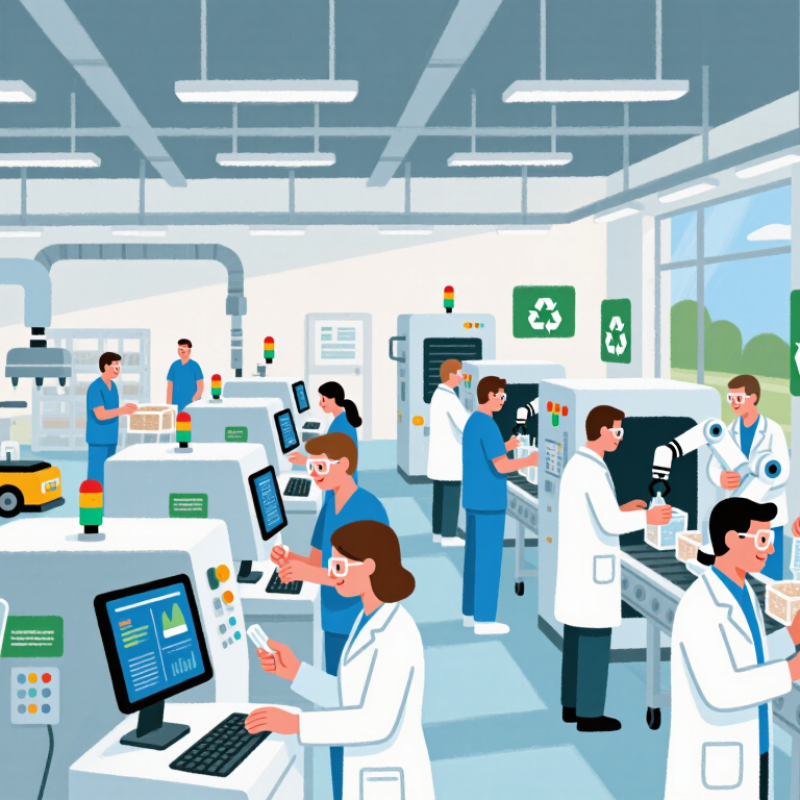
How to Adapt to Future Trends in Healthcare Manufacturing

Defining Future Trends in Healthcare Manufacturing

Future trends in healthcare manufacturing are not simply faster machines. They are measurable shifts in demand, regulation, technology, and supply risk.

The OECD reported that health spending reached 9.2% of GDP across member countries in 2022.

This pressure encourages manufacturers to produce safer devices with fewer delays and less waste. Demand is becoming less predictable.

The World Health Organization’s Global Atlas of Medical Devices identifies more than two million medical device types worldwide. That complexity makes standardization difficult.

Meanwhile, the International Federation of Robotics reported 541,302 industrial robots installed globally in 2023. Automation can improve repeatability, but it cannot replace sound process design.

A robotic arm still needs validated instructions, trained technicians, and reliable maintenance records. Digital traceability will also expand, linking raw materials, machine settings, inspections, and field performance.

Sustainability is becoming a manufacturing requirement, not a public-relations option.

The International Energy Agency reported that industry accounted for about 37% of global energy use in 2022. Healthcare factories will need practical reductions in electricity, water, packaging, and scrap.

Small changes matter: shorter cleaning cycles, reusable fixtures, and sensors that detect abnormal heat early.

Yet forecasts can be overconfident. Some companies may automate too soon, before fixing poor workflows. The better approach is to test one production cell, measure quality and energy use, then adjust the plan.

Assessing Their Impact on Healthcare Production Systems

Healthcare manufacturers are redesigning production around connected equipment, predictive analytics, robotics, and smaller personalized batches. These trends can raise output, but their effects must be measured on the factory floor. A sensor detecting temperature drift may prevent rejected materials. It can also create false alarms and interrupt a stable line. Production leaders should compare downtime, yield, deviation rates, and maintenance costs before expanding a pilot. Numbers matter more than attractive demonstrations.

In practice, future systems change work as much as machinery. Operators need training to interpret dashboards, question automated recommendations, and document decisions. Engineers must connect new tools with existing equipment without weakening traceability. Every software update can affect validated processes, data integrity, or release timelines. Controlled testing, access limits, audit trails, and human approval remain essential. Small trials reveal problems that planning documents often miss. They also expose uneven digital skills across shifts. That is uncomfortable, but useful.

Supply resilience deserves equal attention. Local capacity, dual sourcing, spare components, and secure data recovery can reduce disruption during shortages. However, redundancy increases capital and maintenance demands. Not every facility needs the same level of automation. Assessment should examine product complexity, workforce readiness, energy use, and patient risk. Our early assumption that faster equipment always improved performance was wrong. Cleaning delays and changeover errors erased much of the gain. Weekly reviews now track these gaps after each major process change.

Building Flexible and Resilient Manufacturing Capabilities

How to Adapt to Future Trends in Healthcare Manufacturing

Building Flexible and Resilient Manufacturing Capabilities

Flexible and resilient manufacturing starts with visibility, not expensive automation. The FDA’s Drug Shortages report found that manufacturing problems caused 62% of shortages examined. That figure still matters. A failed filling line can delay patient care, even when forecasts look stable. Plants should map critical materials, qualify alternate suppliers, and design equipment for rapid changeovers. Modular rooms, digital batch records, and common data standards can reduce dependence on one process or technician. Yet digital tools cannot repair weak procedures. A common plant-floor mistake is automating a bottleneck before measuring it. The result can be faster confusion.

Tips: Keep a live risk register. Test one supplier substitution each quarter. Run short changeover drills with operators, maintenance staff, and quality teams. Record the minutes, not only the final outcome. Preserve manual workarounds when systems fail.

Workforce flexibility needs equal attention. The World Economic Forum’s Future of Jobs Report 2023 states that 44% of workers’ core skills may change by 2027. Cross-training should cover sterile technique, data integrity, equipment troubleshooting, and deviation review. Use small simulation exercises on the shop floor. Review lessons after every disruption. Resilience requires safe recovery, clear decisions, and disciplined learning. Document each lesson before the next batch starts.

How to Adapt to Future Trends in Healthcare Manufacturing - Building Flexible and Resilient Manufacturing Capabilities

Trend or Risk Driver Verified Data Point Manufacturing Implication Recommended Capability Reference
Population Aging The global population aged 60 years or over is projected to increase from 1.0 billion in 2020 to 1.4 billion by 2030 and 2.1 billion by 2050. Demand is likely to grow for chronic-care products, assistive devices, diagnostics, and easy-to-use drug-delivery systems. Use modular product platforms, adjustable tooling, ergonomic design controls, and scalable assembly cells. United Nations, World Population Ageing 2020
Noncommunicable Diseases Noncommunicable diseases caused approximately 41 million deaths in 2019, representing about 74% of all deaths globally. Manufacturers need sustained capacity for diagnostics, monitoring equipment, treatment products, and home-based care solutions. Create flexible lines that can switch between product variants while preserving validated process parameters. World Health Organization, Noncommunicable Diseases Fact Sheet
Supply-Chain Disruption The COVID-19 pandemic demonstrated that international transport interruptions, export restrictions, and regional shutdowns can rapidly affect healthcare-product availability. Single-source dependencies and long replenishment cycles increase the risk of production stoppages. Qualify alternate suppliers, maintain risk-based safety stock, localize critical operations, and map tier-two and tier-three suppliers. World Health Organization, COVID-19 Supply Chain System Updates
Healthcare Environmental Footprint Healthcare is estimated to account for approximately 4.4% of global net greenhouse-gas emissions. Energy-intensive production, sterilization, cold-chain requirements, and disposable materials create cost and sustainability pressures. Measure energy and emissions by product family, improve equipment efficiency, reduce material waste, and assess lower-impact packaging. Health Care Without Harm and Arup, Health Care’s Climate Footprint
Healthcare Waste Approximately 85% of healthcare waste is general, non-hazardous waste, while about 15% is hazardous waste. Poor segregation increases disposal cost, safety risk, and environmental impact across manufacturing and care-delivery systems. Design for material separation, improve waste segregation, optimize batch sizes, and use validated recycling or recovery routes where permitted. World Health Organization, Health-Care Waste Fact Sheet
Antimicrobial Resistance Bacterial antimicrobial resistance was directly responsible for an estimated 1.27 million deaths globally in 2019. Demand may increase for rapid diagnostics, infection-control products, antimicrobial treatments, and validated contamination-control processes. Strengthen environmental monitoring, contamination prevention, rapid testing, and capacity for small-volume or specialized production. Murray et al., The Lancet, 2022
Digital and Connected Manufacturing The adoption of connected sensors, electronic records, and automated inspection is expanding across regulated manufacturing, although implementation maturity varies by facility. Real-time process visibility can reduce downtime and improve traceability, but data integrity and cybersecurity become essential. Deploy validated data systems, equipment monitoring, electronic batch records, role-based access, backups, and cybersecurity controls. U.S. Food and Drug Administration, Data Integrity and Compliance With Drug CGMP
Regulatory Volatility Medical-device and pharmaceutical manufacturers operate under risk-based quality-management, validation, traceability, and post-market surveillance requirements. Product changes, supplier changes, and process transfers can require documented impact assessments and regulatory submissions. Use design-for-compliance, standardized documentation, change-control governance, digital traceability, and transfer-ready process packages. International Organization for Standardization, ISO 13485:2016; International Council for Harmonisation, ICH Q10
Workforce and Skills Advanced manufacturing requires combined capabilities in process engineering, automation, quality systems, data analysis, maintenance, and regulatory compliance. Skill shortages can limit technology adoption, increase qualification time, and make recovery from disruptions slower. Develop cross-training matrices, standardized work, simulation-based training, knowledge-retention systems, and succession plans. World Economic Forum, Future of Jobs Report 2023
Planning note: External figures are global estimates or projections and should be translated into site-specific targets through validated risk assessments, demand scenarios, and regulatory requirements.

Adopting Digital Technologies and Data-Driven Processes

Healthcare manufacturing is moving toward connected, evidence-based operations. Digital technologies now link equipment, materials, and quality records across the factory. A sensor can reveal temperature drift before a batch leaves controlled storage. Machine learning may identify unusual vibration in a filling line. Yet useful prediction depends on clean, traceable data.

Poor timestamps create confident but misleading alerts. We learned this the hard way. Our first dashboard looked impressive, but operators could not explain several warnings. The system needed clearer thresholds, maintenance context, and human review. Digital adoption is not simply an IT purchase. It changes daily decisions.

A practical data strategy starts with a narrow, measurable process. Teams might track changeover time, deviation frequency, or equipment downtime. They should define ownership for every field and record why each value matters. Standardized formats reduce errors between production, engineering, and quality teams. Role-based access, encrypted records, and routine backups protect sensitive information.

Validation checks should run before data supports release decisions. Start with one line. Compare manual records with automated entries for several weeks. Review false alarms, missing data, and operator workload. Then adjust the workflow before expanding it. Independent audits and documented training strengthen trust in the results. Automation still needs judgment. A model can miss a rare failure because historical data contains too few examples. Manufacturers should challenge its assumptions, test edge cases, and keep a clear fallback process.

Developing Workforce Skills and Measuring Long-Term Readiness

Healthcare manufacturing readiness depends on people, not only automation. The World Economic Forum’s Future of Jobs Report 2025 estimates that 39% of workers’ core skills may change by 2030. Manufacturers should train technicians in data interpretation, cybersecurity, equipment validation, and quality risk management.

A useful program starts on the production floor. A technician can practice reading sensor trends, investigating a deviation, and documenting corrective actions on a simulated batch record. Cross-training matters. Operators should understand basic statistics, while engineers should observe sterile-area routines. The Manufacturing Institute and Deloitte project that manufacturing may need 3.8 million new workers in the United States by 2033, with 1.9 million roles potentially remaining unfilled. Healthcare manufacturers cannot treat recruitment as the only answer.

Our first skills matrix was too optimistic. It listed training completion, but not independent performance under pressure. A stronger readiness score combines qualification results, audit findings, downtime responses, and annual skill renewal. Track the time needed to resolve deviations. Track recurring errors. Review results every quarter.

Small gaps become expensive. A missed data-integrity lesson can delay release decisions or weaken inspection confidence. Long-term readiness also requires partnerships with technical schools and structured mentoring for younger workers. Training must include judgment, not just software clicks. The World Health Organization continues to emphasize competent health-workforce development as a foundation for safe, resilient systems. Some plans will fail. That failure should become evidence for the next training cycle.

FAQS

What are the main future trends in healthcare manufacturing?

Key trends include automation, digital traceability, sustainable production, and stronger control of supply risks. They are not only faster machines. Demand may remain difficult to predict.

How can automation improve healthcare manufacturing?

Robots can repeat precise movements and reduce variation on routine tasks. A robotic arm still needs validated instructions, trained technicians, and maintenance records. Automation alone solves less than expected.

Why is process design important before automation?

Poor workflows can make automated errors faster and harder to notice. Test one production cell first. Measure quality, energy use, downtime, and operator workload before expanding.

What does digital traceability connect?

It can link raw materials, machine settings, inspections, and field performance. These records create a clearer production history. Missing timestamps can still mislead everyone.

How can sensors support manufacturing quality?

Sensors may detect temperature drift or unusual equipment vibration early. For example, an alert can appear before controlled storage conditions fail. Human review remains necessary.

What makes manufacturing data trustworthy?

Data needs clear ownership, consistent formats, validation checks, and documented training. Teams should compare automated entries with manual records for several weeks. Impressive dashboards are not enough.

How should factories approach sustainability?

Practical targets include lower electricity, water, packaging, and material scrap. Shorter cleaning cycles, reusable fixtures, and heat sensors can help. Small savings add up, though forecasts may be too optimistic.

What risks come with machine-learning systems?

A model may miss rare failures when historical data contains few examples. Teams should test unusual conditions and challenge model assumptions. Keep a fallback process. It matters.

Conclusion

Adapting to Future Trends In Healthcare Manufacturing Technology requires organizations to understand how emerging changes may reshape production, quality management, supply chains, and regulatory expectations. By assessing the potential impact of automation, connected systems, advanced analytics, sustainable practices, and personalized production models, manufacturers can identify operational risks and prioritize practical improvements. This forward-looking approach helps align investment decisions with evolving healthcare needs while protecting product consistency and patient safety.

Long-term readiness depends on building flexible and resilient manufacturing capabilities that can respond to demand fluctuations, disruptions, and new production requirements. Companies should adopt digital technologies and data-driven processes to improve visibility, support faster decision-making, and strengthen quality control. At the same time, developing employee skills in technology, problem-solving, compliance, and continuous improvement is essential. Regularly measuring readiness through performance indicators, workforce assessments, and resilience reviews allows organizations to track progress and adjust their strategies as future trends continue to develop.

Aria

Aria

Aria is a dedicated marketing professional with a deep passion for innovative strategies and a keen understanding of our company's product offerings. With a wealth of experience in the industry, Aria excels at crafting engaging content that highlights the unique features and benefits of our......